

Key Takeaways
- Two-year-olds learn best through repeated, low-pressure play that mixes physical movement, language exposure, and sensory exploration throughout the day
- Structured routines and unstructured free play each offer unique benefits, and the strongest results come from blending both rather than choosing one approach
- Fine motor skills like turning knobs, stacking, and self-feeding often need more practice than parents realize, since they underpin later writing and dressing abilities
- Reading aloud consistently outperforms screen-based language apps for building vocabulary at this age because it includes conversation and emotional connection
- Outdoor play delivers gross motor, sensory, and social-emotional gains in one package, making it one of the most time-efficient choices for busy caregivers
- Parent-led activities and child-led play serve different purposes, and following the toddler’s lead usually produces deeper engagement
- Small daily habits matter far more than expensive toys or elaborate curriculums at this stage
Why the Toddler Years Matter More Than You Think
The stretch between a child’s second and third birthday is one of the most explosive growth periods you will ever witness as a parent. Brain connections are forming at a staggering rate. Language is unfolding week by week, motor skills are sharpening, and personality is taking real shape right in front of you.
What makes this age so unique is how quickly ordinary moments turn into learning. A walk to the mailbox becomes a vocabulary lesson. Stacking blocks becomes a physics experiment. Even a messy snack time trains the small muscles your child will eventually use to hold a pencil. The question most parents wrestle with is not whether to support this growth, but how to do it without turning every hour into a scheduled lesson.
This guide compares the most common approaches parents take, weighs their strengths and weaknesses, and helps you build a daily rhythm that actually fits real life.
Structured Routines Versus Free Play: Which Wins?
Parents tend to fall into two camps. Some lean heavily on structured schedules with themed activities, flashcards, and planned lessons. Others take a looser approach, trusting that toddlers will learn naturally through play. Both camps have a point, but the research consistently favors a hybrid.
Structured activities offer predictability, which toddlers crave. A set circle time, a daily puzzle, or a nightly book routine builds anticipation and helps a two-year-old feel secure. On the other hand, unstructured play lets children test ideas, make mistakes, and solve problems without an adult directing every move. That kind of self-directed exploration is where creativity and executive function begin to form.
A good rule of thumb is to anchor the day with two or three predictable rituals and leave wide-open stretches in between. Try something like this:
- A morning movement routine (dancing, stretching, a short walk)
- One sit-down activity like puzzles, play dough, or sorting
- A read-aloud session before nap and before bed
- At least two blocks of 30 to 60 minutes of free, child-led play
- One outdoor outing, even if it is just the backyard
When to Step Back and Let Them Lead
Watching a toddler stare at a leaf for ten minutes can test anyone’s patience, but this is exactly when learning deepens. If you jump in with questions or redirect too soon, you interrupt the thinking process. The better move is to sit nearby, stay quiet, and only respond when your child invites you in. You will be surprised how often they come to you.
Building Language Through Everyday Talk

Language development at this age is remarkable. According to the American Academy of Pediatrics, a two-year-old typically speaks with a quickly expanding vocabulary of fifty words or more, and that number climbs fast. Most toddlers at this age can produce somewhere between two hundred and three hundred words by the time they near their third birthday. The range is wide, and that is normal.
The question becomes how to feed that growth. Parents often compare two main options: language-focused apps and simple conversation. Apps are convenient, but they lack the back-and-forth exchange that actually wires the language centers of the brain. Real conversation, even messy or one-sided conversation, consistently produces better outcomes. Reading aloud is the single most reliable language booster you can offer, especially when you pause to let your child point, name, or ask.
Try weaving language into things you already do:
- Narrate what you are cooking, folding, or packing
- Ask open-ended questions like “what should we do next?”
- Repeat and expand what your child says (“ball” becomes “yes, a big red ball”)
- Sing the same songs over and over, since repetition locks in words
- Read the same book many times, even when you are tired of it
Why Bilingual Exposure Works at This Age
If a second language is part of your family, this is a prime window. Toddlers absorb sound patterns effortlessly, and consistent exposure, even from one caregiver or one daily routine, pays off for years. You do not need formal lessons. You just need regular, meaningful use of the language in context.
Fine Motor and Gross Motor: Finding the Right Balance
Physical development at this age is huge. According to UNICEF, by age two your child is walking, climbing, jumping, running, and overflowing with energy. All that movement is not just burning calories. It is building the coordination and body awareness needed for everything from stairs to scissors.
Gross motor skills get most of the attention because they are visible and loud. Fine motor skills, though, often get overlooked. These are the small, precise movements that let a child feed themselves, button a shirt, or eventually write. Parents who focus only on running and climbing can miss the quieter practice that matters just as much.
Good developmental activities for 2 year olds should hit both sides. A balanced week might include climbing at the park, dancing in the living room, pouring water between cups, threading large beads, and squeezing play dough. Variety matters more than any single activity being perfect.
Simple fine motor practice ideas include:
- Pulling stickers off a sheet and placing them on paper
- Transferring pom-poms with tongs or fingers
- Scribbling with chunky crayons
- Opening and closing containers with lids
- Pressing play dough with cookie cutters
Sensory Play Compared With Traditional Toys
Walk into any toy store, and you will see shelves of plastic gadgets promising to boost early childhood development. Compare that with a bin of dry rice, a few scoops, and some small cups. Which one actually does more? In most cases, the simpler setup wins.
Sensory play engages multiple senses at once, which deepens learning. It also tends to hold a toddler’s attention far longer than battery-powered toys that do the thinking for them. Traditional toys like blocks, dolls, and toy cars still have real value because they invite pretend play and sustained problem-solving. The toys that tend to underperform are the flashing, singing ones that leave your child as a passive watcher rather than an active participant.
A rotating sensory bin costs almost nothing and offers endless variety. One week it might be dry pasta and measuring spoons. The next, cotton balls and tongs. The week after, water with floating corks. Keep the setup small, supervise closely, and rotate materials before boredom sets in.
Setting Up Sensory Play Without the Mess Taking Over
Mess is the main reason parents avoid sensory play, but a few small adjustments make it manageable. Lay down an old sheet or shower curtain. Keep the bin on a tray with raised edges. Set clear rules from the start, like materials stay in the bin, and end the session before your toddler loses interest and starts throwing things. Cleanup becomes part of the routine, which itself teaches responsibility.
Outdoor Play as a Daily Non-Negotiable
If you could only commit to one category of enrichment each day, outdoor time would be the strongest choice. It layers physical movement, sensory input, social encounters, and open-ended discovery into a single experience. A toddler who spends an hour outside has usually practiced balance, negotiated with another child, examined a bug, and tested the limits of their own body all without a single structured prompt from you.
Weather is rarely the real obstacle. With the right layers, most days work. The harder challenge is giving yourself permission to let the outing be slow. A walk around the block might take forty minutes because every crack in the sidewalk deserves inspection. That is not a failure of the outing. That is the outing doing its job.
If you want a broader view of how these habits connect to later skills, this early childhood milestones timeline lays out what to expect from infancy through the first years of school.
Social and Emotional Growth Through Play
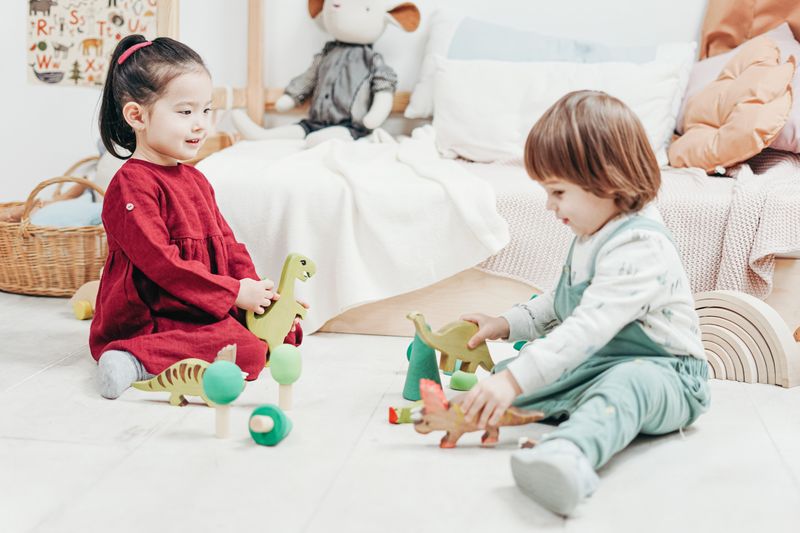
Two-year-olds are famous for big feelings and small vocabularies to describe them. This gap is where most meltdowns live. The activities that help here are not formal lessons in emotion. They are everyday moments where a caregiver names what the child is feeling, models calm responses, and gives the child words to use next time.
Parallel play is the dominant social mode at this age. Your toddler may sit next to another child, build their own tower, and barely acknowledge the other kid, yet still be learning volumes about sharing space, watching behavior, and tolerating differences. Pushing for cooperative play too early usually backfires. Let it emerge on its own schedule.
Helpful social-emotional practices include:
- Naming emotions out loud as you notice them, both yours and theirs
- Reading books that feature characters working through feelings
- Using simple pretend play with dolls or stuffed animals to act out routines
- Offering choices between two acceptable options to build autonomy
- Keeping transitions predictable with warnings and simple songs
Handling Tantrums as Learning Moments
A tantrum is not misbehavior. It is a nervous system that has run out of capacity. The most useful response is usually the least dramatic one. Stay close, stay calm, keep words to a minimum, and wait. Once the storm passes, a brief conversation about what happened helps your child start linking feelings to language. Over months, this is how self-regulation grows.
Building a Realistic Daily Rhythm
Pulling all of this together can feel overwhelming on paper, but the actual day is simpler than it sounds. Most toddlers thrive on a loose, predictable arc: wake, eat, play, outing, lunch, nap, play, outing, dinner, wind-down, bed. Inside that arc, you can slot in reading, sensory bins, fine motor practice, and movement without planning each one in advance.
A sample rhythm might look like:
- Morning: breakfast, free play while you clean up, a short structured activity like puzzles
- Mid-morning: outdoor outing or walk
- Lunch and nap
- Afternoon: sensory bin or art, followed by free play
- Late afternoon: second outdoor stretch or a visit with family
- Evening: dinner, bath, two or three books, bed
Notice how little of this requires special equipment, planning, or money. The ingredients are time, attention, and a willingness to let your toddler lead when it makes sense.
Conclusion
The pressure to do everything right during the toddler years is real, but the actual recipe is forgiving. Toddlers do not need curated enrichment schedules or shelves of expensive gear. They need a steady adult who talks with them, reads with them, lets them get messy, and gives them room to try things on their own. The small, repeated choices you make across an ordinary Tuesday matter far more than any single standout activity.
If you take nothing else from this guide, take this: trust the ordinary. A walk, a book, a bin of water, a conversation about what you see out the window. These are not filler between the important stuff. They are the important stuff. Your toddler is learning constantly, and your presence is the single most valuable resource in the room.
Keep expectations flexible, watch your child for cues about what they need next, and give yourself grace on the hard days. Growth at this age is not linear, and neither is parenting it. Show up consistently, follow their lead when you can, and the rest tends to take care of itself.